 Joel Libava
Here’s a number that might surprise you: Ohio has 46.43 fast food restaurants per 100,000 residents. That means it’s one of the fast food franchise capitals in the USA. It’s #5, actually.
But what does this really tell us about franchise opportunities?
A lot more than you’d think. Let’s dig into what these numbers actually mean for your franchise investment decision.
Note: I thought I’d focus a little on Ohio in this post, since that’s where my Castle is located.
Key Takeaways
Ohio ranks as one of America’s fast food franchise capitals with 46.43 locations per 100,000 residents. This signals strong consumer demand. But it also means intense competition. However, prime territories are likely already claimed by existing franchisees.
Translation: you’re entering a crowded marketplace where customers have multiple options within every five-mile radius. High concentration proves the business model works…but it also means fighting for market share rather than creating it.
With that in mind, being one of the fast food franchise capitals doesn’t guarantee success for individual investors. Regional performance varies dramatically by brand and location. Kansas dominates in Pizza Hut while Mississippi excels with Sonic Drive-In.
That said, national rankings don’t predict local profitability. Your specific territory matters more than state-level statistics. Multi-unit operators with 10+ locations have advantages you can’t match as a single-unit owner.
Now, check out this post.
Top 10 Fast Food Franchise Capitals of America
According to new research from Seating Masters, West Virginia leads the nation with 49.04 fast food locations per 100,000 people. Vermont sits at the opposite end with just 27.65…nearly half the concentration. That’s a massive difference. We’re talking about states where fast food is almost twice as accessible in one location versus another.
Furthermore, Ohio’s position in the top 5 reveals something important about consumer demand, market saturation, and franchise viability in the region.
FYI: as of this writing, some of the top fast food franchises are experiencing a downturn in revenue. Why?
Prices.
Their prices are too darn high.
The Top 10 Fast Food Franchise Capitals
- West Virginia (49.04 per 100K)
- Kentucky (47.21)
- Kansas (47.1)
- Mississippi (46.71)
- Ohio (46.43)
- Indiana (46.37)
- Arkansas (46.19)
- Louisiana (45.41)
- Tennessee (44.72)
- Wyoming (44.34)
Notice something? The Midwest and South dominate this list. That’s not accidental.
What Ohio’s Fast Food Franchise Density Really Means for Franchise Buyers
If you’re considering a fast food franchise investment in Ohio, you need to understand what this ranking actually tells you—and what it doesn’t.
The reality check: More locations per capita means franchisors see strong demand here. These companies don’t open locations randomly. They conduct extensive market research, demographic analysis, and traffic studies before approving territories.
But high density also means you’re entering a crowded marketplace where customers have plenty of options within a five-mile radius of any given location.
Ohio hosts 519 Starbucks* locations—the ninth highest concentration in the country. That’s significant market penetration in a state with roughly 11.8 million residents. We’re talking about one Starbucks for approximately every 22,700 people.
Think about your own neighborhood. How many Starbucks can you reach within a 10-minute drive? That’s market saturation at work.
*I don’t consider Starbucks to be a fast food franchise.
Heck, it’s not really a franchise at all.
The Subway Domination Factor in the Fast Food Franchise Capitals
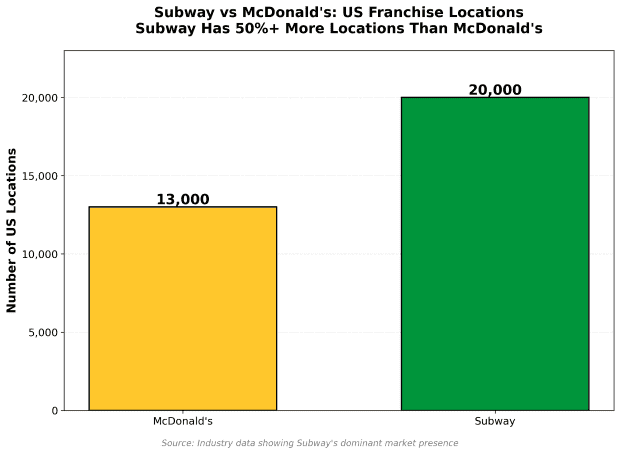
Here’s something most franchise buyers don’t realize: Subway has over 50% more locations than McDonald’s does nationwide. Let that sink in for a moment.
For instance, in Kentucky alone, Subway operates 362 franchises. That’s 8 restaurants per 100,000 people. In West Virginia, there are 164 Subways compared to 104 McDonald’s. In Ohio, Subway’s presence is similarly dominant.
Why does this matter for your franchise buying decision?
Because brand saturation directly impacts your franchise territory availability and competitive positioning. A dominant chain like Subway means fewer prime territories remain available for new franchisees in that system.
When I evaluate franchise opportunities for clients, I always ask: “How many of this brand’s franchises already exist in your target market?”
That being said, you might love the Subway brand, but if there are already 6 locations within a five-mile radius of where you want to operate, your territory options become severely limited. The market may be oversaturated.
The Saturation Reality:
- Established territories are already claimed by existing franchisees
- Prime locations (high-traffic intersections, shopping centers) are typically taken first
- Secondary and tertiary territories mean lower visibility and traffic
- Your protected territory might be smaller than you’d prefer
Regional Brand Performance: Not All Franchises in the Fast Food Franchise Sector Succeed Everywhere

Kansas stands out with 165 Pizza Hut locations, 120% more than Domino’s and Papa John’s combined in that state.
Meanwhile, Mississippi, one of the top fast food franchise capitals, shows exceptionally strong performance for Sonic Drive-In, Wendy’s, and Burger King with 307 combined locations.
These regional brand preferences tell you something critical: not every franchise performs equally in every market.
I’ve seen franchise buyers fall in love with a brand because it’s successful in California or Florida, only to struggle when they open that same concept in Ohio or Alabama. Consumer preferences vary by region, demographics, income levels, and local culture.
Regional Performance Factors:
- Climate and geography: Drive-through concepts like Sonic perform differently in warm climates versus cold winters
- Demographics: Chipotle (not a franchise) succeeds in markets with younger, higher-income populations
- Local competition: Regional chains often have loyal followings that national brands struggle against
- Real estate costs: Premium brands like Five Guys need higher-income markets to support their price points
What About Whataburger?
It’s important to look at Arkansas, which is one of just 12 states with a Whataburger fast food restaurant presence.
In this state, there are only 4 locations total. That’s either an opportunity for growth or a sign that the brand hasn’t found its market fit there yet. You need to know which one it is before you invest.
In any franchise or in any market.
Franchise Investment Implications: Reading Between the Numbers
When you see states with higher fast food density, you’re looking at specific market indicators that affect your investment thesis.
Market Indicators:
Check Out My New Guide for Franchise Buyers!

- Strong consumer demand for quick-service dining (people eat out frequently)
- Established franchisee support infrastructure: (suppliers, vendors, service providers understand franchising)
- Proven territory performance data: (franchisors have years of sales data to share)
- Higher competition for customer dollars (your marketing has to work harder)
Investment Considerations:
- Territory availability may be limited in top-performing areas (the best spots are taken)
- Real estate costs in proven markets often run higher (landlords know franchise tenants are desirable)
- Established competitors have loyal customer bases (you’re fighting for market share, not creating it)
- New entrants need differentiation strategies (being “another burger place” won’t cut it)
Let me be brutally honest here: High franchise density can be a double-edged sword.
On one hand, it proves the business model works in that market. Franchisors wouldn’t continue opening locations if existing ones weren’t profitable.
On the other hand, you’re buying into a market where customers have choices…lots of them.
The Multi-Unit Franchisee Reality In Fast Food
Here’s something else these numbers reveal: In high-density markets like Ohio, Kentucky, and Indiana, you’re competing against multi-unit franchise operators who own 5, 10, or even 20+ locations of the same brand.
These operators have:
- Economies of scale you can’t match as a single-unit owner
- Established relationships with suppliers
- Refined operational systems
- Marketing budgets that dwarf yours
- First access to new territories when they become available
When Subway has 362 locations in Kentucky, another one of the fast food franchise capitals, many of those are owned by multi-unit operators who’ve been in the system for 15+ years. You’re the new kid on the block competing against experienced operators with proven track records. So, know that going in.
Fast Food Franchising: The Item 19 Earnings Reality Check
The Federal Trade Commission doesn’t requires franchisors to provide Item 19 financial performance representations in their Franchise Disclosure Document. It’s optional. Some do and some don’t. Personally, I don’t care if they do or not. Why?
Because the franchisees will tell you how much revenue they’re bringing in…and even how much they’re making if you know how to ask them.
Note: The Definitive Guide to Franchise Research shows you exactly how to ask franchisees the “money” questions.
That said, here’s what I tell every client who works with me: State-level rankings and national statistics mean absolutely nothing compared to actual franchisee earnings data.
At minimum, you need to ask:
- What’s the median gross revenue for franchisees in my specific region?
- What percentage of franchisees achieve the advertised performance levels?
- What are the actual operating costs in my territory (labor, rent, food costs)?
- How long does it typically take to reach break-even?
- What percentage of franchisees renew their franchise agreements?
Finally, Ohio might rank 5th nationally for fast food density, but that doesn’t tell you whether the Burger King franchise available in Akron is profitable or struggling.
Due Diligence Steps:
- Review Item 19 data in the FDD thoroughly
- Call current franchisees in similar markets (the FDD provides contact information)
- Talk to franchisees who left the system (ask the franchisor for this list)
- Analyze local competition specific to your territory
- Calculate your realistic break-even point based on actual data, not projections
- Hire a seasoned franchise attorney
Top 10 Fast Food Franchise Capitals: What The 22-Chain Study Includes (and Excludes)
This research examined 22 major fast food franchises: Arby’s, Chick-fil-A, Chipotle, Dairy Queen, Domino’s, In-N-Out, KFC, Dunkin’, Five Guys, Wendy’s, White Castle, Whataburger, Sonic Drive-In, Subway, Taco Bell, McDonald’s, Papa John’s, Pizza Hut, Starbucks, Popeyes, Burger King, and Raising Cane’s.
Notice what’s NOT on that list? Hundreds of other franchise concepts operating in these same markets.
Remember, fast food represents just one segment of the quick-service restaurant category.
Now, add in fast-casual concepts, coffee shops, dessert franchises, and quick-service Asian concepts, and the actual density of competing food service franchises is significantly higher.
Finally, when you’re evaluating a franchise investment, you’re not just competing against the 22 brands in this study. You’re competing against every restaurant option within a customer’s convenience radius.
Questions Smart Franchise Buyers Ask

Before you get excited about Ohio’s 5th-place ranking or any of the other fast food franchise capitals, you need to ask harder questions:
Territory-Specific Questions:
- What’s the actual performance data for specific territories I’m considering?
- How saturated is my target brand in my specific five-mile radius?
- What are the demographics and traffic patterns in my potential location?
- Am I buying into a growth market or a mature, saturated one?
- How many competing concepts exist in my immediate area?
Financial Performance Questions:
- What’s the average unit volume (AUV) for franchisees in similar territories?
- What percentage of revenue do top-performing franchisees achieve?
- What’s the failure rate for new franchisees in the first three years?
- How much working capital do successful franchisees actually need beyond the initial investment?
Operational Reality Questions:
- Can I hire and retain qualified staff in my market at prevailing wage rates?
- What are the real estate options, and costs for my concept?
- Do I have the operational skills to run this business, or will I need a manager?
- What’s my realistic time commitment, and does that align with my goals?
The Fast Food Franchise Capitals: The Midwest and Southern Franchise Advantage
Looking at the top 10 list, remember that 9 of the 10 states are in the Midwest or South. Wyoming is the outlier. And it’s a super business friendly state. Look
This tells you something about franchise economics in these regions:
Lower Barriers to Entry:
- Real estate costs are generally lower than coastal markets
- Labor costs are typically more affordable
- Franchise fees may be structured more favorably for smaller markets
Different Consumer Behaviors:
- Car-dependent infrastructure supports drive-through concepts
- Fast food is culturally more accepted as a regular dining option
- Lower cost of living means budget-friendly dining options perform well
Franchisor Strategies:
- Brands aggressively develop these markets because the unit economics work
- Territory sizes may be smaller due to population density considerations
- Multi-unit development deals are common
Bottom line?
If you’re in Ohio, you’re in a market that franchisors clearly want to be in. That’s validation of the market—but it’s also a warning about competition.
The Vermont Comparison: Less is Sometimes More

Vermont has 27.65 fast food restaurants per 100,000 residents—the lowest in the nation and almost half of West Virginia’s concentration.
Does that mean Vermont is a bad market for fast food franchises? Not necessarily.
Vermont has:
- Higher average household incomes
- A culture that values local, independent restaurants
- Smaller population centers (harder to support multiple national chains)
- Consumer preferences that skew toward higher-quality dining experiences
For instance, a Five Guys in Burlington, Vermont might outperform a Five Guys in West Virginia because Vermont consumers have fewer competing options and higher disposable incomes.
Market density is one data point. It’s not the whole story.
Read that again.
What This Means for Your Fast Food Franchise Purchasing Decision
Let’s bring this back to what matters: your money and your future.
Ohio’s position as America’s 5th-most concentrated fast food market signals opportunity—and competition. High density can mean proven demand. It can also mean market saturation.
Continue Learning About Franchising
Check out these important franchise trendsGet the latest franchise research tips
Learn how to choose the right franchise for you
Educate yourself about some of the franchise legal stuff
Get specific advice on owning and operating a franchise

Your investment decision shouldn’t be based on where your state ranks nationally.
It should be based on:
1. Specific Territory Analysis: Map out every competing concept within your protected territory. Use Google Maps. Drive the area. Count the competition.
2. Actual Franchisee Earnings: Conversations with current franchisees. Real numbers, not marketing promises.
3. Your Capital Requirements and Financing: Can you secure financing? Do you have adequate working capital for the first 12-18 months? What’s your contingency fund if revenue falls short?
4. Your Operational Capabilities: Can you hire and train staff? Manage inventory? Handle customer complaints at 8 PM on a Saturday? Run payroll and manage cash flow?
5. Professional FDD Review: Hire a franchise attorney who specializes in FDD review. This is non-negotiable. The franchise agreement governs your business relationship for 10 years or more.
The Brutal Truth About Fast Food Franchising
Fast food franchises can be solid investments. The business model is proven. The systems work. The brand recognition is real. The revenue can be high.
But rankings and statistics like “The Top Fast Food Franchise Capitals,” don’t replace thorough due diligence on the specific opportunity you’re evaluating.
The fact is, I’ve helped clients walk away from franchise opportunities that looked great on paper but fell apart under scrutiny. I’ve also helped clients move forward with investments in saturated markets because the specific territory and financial performance justified the risk.
Your decision needs to be based on facts, not feelings. Data, not dreams.
Look, Ohio might be the 5th-most concentrated fast food market in America, but that fact alone shouldn’t determine whether you invest $250,000 to $500,000 in a franchise opportunity there.
So, do the work. Ask the hard questions. Hire professionals to review the documents. Talk to franchisees who succeeded…and those who failed.
Because your investment in a franchise deserves brutal honesty, not a sales pitch.
Frequently Asked Questions
Ohio has 46.43 fast food restaurants per 100,000 residents, ranking fifth nationally. This means franchisors see strong consumer demand in Ohio markets. However, it also indicates significant competition and potential market saturation. High density proves the business model works but means you’re competing for existing customers rather than creating new demand. Decide if that’s what you want in a business.
High density is a double-edged sword. It validates that the market supports franchise operations and provides proven performance data. But it also means prime territories are often claimed, real estate costs run higher, and you face established competitors with loyal customer bases. Your success depends on finding an available territory with strong demographics and manageable competition.
Subway has over 50% more US locations than McDonald’s due to lower startup costs and smaller footprint requirements. In Kentucky alone, Subway operates 362 franchises compared to far fewer McDonald’s. This dominance affects territory availability—if you’re considering a Subway franchise, prime locations may already be taken by existing franchisees or multi-unit operators.
Start with the Franchise Disclosure Document. And call current franchisees in markets similar to yours and ask about actual earnings, expenses, and challenges. Hire a franchise attorney to review the franchise agreement. Map your competition within a five-mile radius. Calculate realistic break-even timelines based on actual costs, not projections. Only invest after completing comprehensive due diligence.
Ohio’s ranking proves franchisor confidence in the market. But your decision shouldn’t be based on state statistics. You need territory-specific analysis, actual franchisee earnings information, and professional FDD review by a franchise attorney. Talk to current franchisees in similar markets. Evaluate local competition within your specific radius. Make decisions based on data, not rankings.
About the Author
Joel Libava is The Franchise King® — an independent franchise advisor with 25+ years in the industry, two published books on franchising, and his writing has been featured in The New York Times, Forbes, CNBC, Entrepreneur® Magazine and others. In addition, he wrote exclusively for the U.S. Small Business Administration blog for eight years. He doesn't sell franchises. Instead, Joel helps you figure out if franchise ownership is actually right for you — and if it is, teaches you his powerful, proven-to-work franchise research techniques, so you can make a smart, informed decision on a franchise to own and be your own boss.
Note: When you buy through links on this website, we may earn an affiliate commission.