 Joel Libava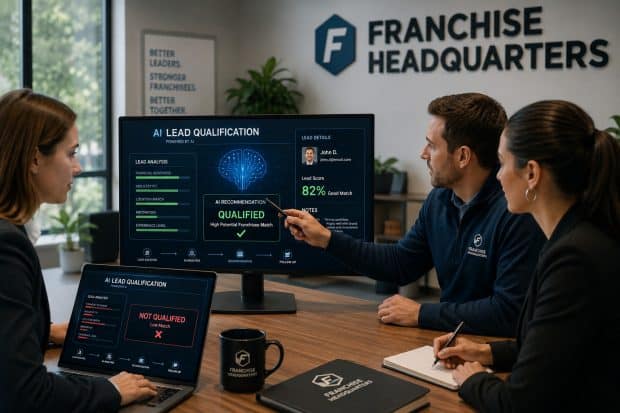
I’m going to share some surprising information on how franchisors are using AI to dig through your past. Wait. Why are they doing that?
Because they want to use that information to determine if you’re worthy of their franchise brand.
Keep reading, so you can understand what a lot of today’s franchisors are starting to do. And how you’ll be impacted by how they’re using AI.
Key Takeaways on Franchisors Using AI
Franchise development teams are increasingly running applicant data through AI scoring tools before a human recruiter ever engages. These AI tools pull credit signals, background information, and sometimes public social media activity to generate a “fit score” or risk rating.
Here’s what that means for you.
A low score can mean your inquiry quietly disappears, with no explanation and no rejection letter. This isn’t illegal, and it isn’t rare anymore, but it is almost never disclosed to candidates. Knowing this changes how you should approach your first application, your online presence, and your follow-up strategy.
The Quiet Shift Happening on the Franchisor Side
Franchising has quietly flipped a switch.
In the past 12 months or so, franchise buyers have started to use AI to research franchises faster.
Now, franchisors are using AI to research you. Faster. And most aspiring franchisees have no idea it’s happening.
The fact is, for decades, franchise development worked the same way. You filled out a request for information. A recruiter called you. You built a relationship over several conversations. It was slow, human, and imperfect.
Fact: Franchise development departments are under constant pressure to cut cost-per-lead and speed-to-close. AI screening tools promise both. So franchisors are starting to adopt to them fast.
Here’s how it typically works now. You submit an inquiry form. That form feeds into a customer relationship management system layered with an AI scoring model.
Then, the model looks at things like your stated net worth, your credit tier, your employment history, and in some cases, publicly available information tied to your name. It spits out a score. Sales teams are trained to prioritize the highest scores first and deprioritize, or outright ignore, the lowest ones.
The thing is, you never see the score. You just experience the silence. Fun!
Why Franchisors Using AI Scoring Matters More Than It Sounds Like It Should
Some of you are thinking, “So what? Franchisors have always screened applicants.” True.
But there’s a real difference between a human recruiter reading your application and forming a judgment, and an AI-based algorithm making a pass/fail decision before anyone reads a word you wrote.
Notably, AI scoring models are trained on historical data about which past franchisees succeeded.

If that historical data skews toward a certain profile, applicants outside that profile can get filtered out before they ever get a fair look. That’s not a hypothetical. It’s how these systems work by design.
This should matter to you even if you’re a strong candidate.
That’s because a great fit on paper can still get buried by a clunky online form, an outdated credit snapshot, or a scoring model that weighs the wrong signals.
You could be exactly the kind of owner a brand needs, and never know you were filtered out before round one. And that’s wrong.
What You Can Actually Do About It
You can’t see the algorithm. But you can stop feeding it weak signals.
Here’s what you can do to improve the way AI platforms and internal AI models see you.
First, clean up your online footprint before you apply. If a franchisor’s tool is pulling any public data tied to your name, you want that picture to be accurate and current.
Secondly, be super-precise, not vague, on intake forms. Round numbers and hedged answers read as risk to a model built on pattern-matching. Specific numbers for net worth, liquid capital, and timeline read as thought-out intent.
Next, don’t rely on the online form as your only entry point. If you have a real connection, a referral, an advisor, a franchising attorney, an existing franchisee willing to make an introduction, use it. A human referral can route you around an algorithm entirely.
For instance, maybe your franchise lawyer knows the CEO or CFO of the franchise organization you’re interested in. You can say this:
“A franchise lawyer you know thinks I’d be a great franchisees in your system. Is there any way you and I can talk before I fill out the usual online forms?
Finally, if things go quiet after applying to a brand you were genuinely excited about, don’t assume you did something wrong. Sometimes you did everything right and a scoring model just didn’t know how to read you.
Ask the Question Nobody Else Is Asking
Here’s a bold move almost no franchise buyer makes.

Ask the development rep directly: “Does your team use any AI tools to screen or score applicants before they’re contacted?”
Most reps will be caught off guard. Some will be honest. Their answer, and how comfortable they are giving it, tells you something real about how that franchisor treats candidates.
In reality, a franchise brand that’s transparent about its process is usually more transparent about everything else that follows, including how it treats you once you’re a franchisee.
The Bottom Line About Franchisors Using AI to Screen You
Franchising likes to talk about “finding the right fit.”
Continue Learning About Franchising
Check out these important franchise trendsGet the latest franchise research tips
Learn how to choose the right franchise for you
Educate yourself about some of the franchise legal stuff
Get specific advice on owning and operating a franchise
Increasingly, that fit is being pre-judged by software before a human ever weighs in.
This isn’t something franchisors are hiding out of malice. It’s just not something they advertise, because it doesn’t sound as warm as “we’re looking for passionate, hands-on franchise owners.”
Know that this layer exists.
Present yourself with that in mind.
And don’t mistake algorithmic silence for a verdict on your potential as a franchise owner. Sometimes the smartest move is going around the machine and finding a human who can vouch for you instead.
Frequently Asked Questions
Because they feel it’s more efficient and they can weed through aspiring franchise owners quicker.
I don’t think franchisees are at a disadvantage. They just need to stay ahead of it, and encourage earlier contact with franchise reps.
Of course they do. That said, they’ll continue to get better at using it.
About the Author
Joel Libava is The Franchise King® — an independent franchise advisor with 25+ years in the industry, two published books on franchising, and his writing has been featured in The New York Times, Forbes, CNBC, Entrepreneur® Magazine and others. In addition, he wrote exclusively for the U.S. Small Business Administration blog for eight years. He doesn't sell franchises. Instead, Joel helps you figure out if franchise ownership is actually right for you — and if it is, teaches you his powerful, proven-to-work franchise research techniques, so you can make a smart, informed decision on a franchise to own and be your own boss.
Note: When you buy through links on this website, we may earn an affiliate commission.