You’re Already Using AI to Research Franchises. Are You Using It Right?
Admit it. You’ve probably already typed “best franchise to buy” or “should I buy a [brand name] franchise” into ChatGPT. You got an answer back. It sounded confident. It was also almost certainly incomplete, and possibly wrong in ways you had no way to detect.
That’s not a knock on AI. It’s a knock on using it without a map.
Fact: Today’s franchise buyers ARE using ChatGPT etc. for franchise research, ChatGPT for evaluating franchises, and ChatGPT for franchise due diligence.
And although it’s a young technology, AI is excellent at organizing your research, translating some of the legal language, and generating sharp questions.
But, it’s not able to verify a franchisor’s real financial condition, sit in on your validation calls, or interpret your franchise agreement with any legal authority like an experienced franchise attorney can.
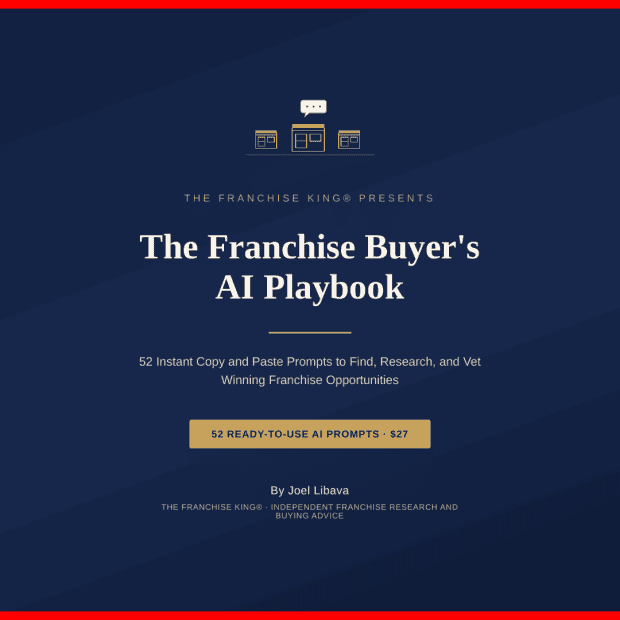
The problem I’ve seen is that most franchise buyers don’t know where that line is. The Franchise Buyer’s AI Playbook draws it for you, 52 times over.
Especially if you want to have the exact questions to feed into ChatGPT to evaluate and research a franchise.
What’s Inside The Franchise Buyer’s AI Playbook
- 13 prompts for finding a franchise that fits. Self-assessment, honest budget planning, skills-to-business matching, and how to screen out a bad fit before you ever request information from a franchisor.
- 26 prompts for researching a franchise. How to read a Franchise Disclosure Document, interrogate an Item 19 financial disclosure instead of accepting the average, prepare for validation calls, and spot franchisor red flags most buyers miss entirely.
- 13 prompts for making the decision. How to synthesize everything you’ve learned, prepare for your franchise attorney meeting, set your walk-away conditions in advance, and avoid signing simply because you don’t want to feel like your research was wasted.
- A full glossary of key terms. FDD, Item 19, Item 20, encroachment, validation call, and every other term this guide uses, explained in plain language, in one place.
- A chapter busting common franchising myths. Including the biggest one: that AI alone can tell you whether a franchise is a good investment.
- Plus a FREE Bonus: The Companion Workbook & 7-Day Quick-Start Plan. A fillable workbook with three worksheets, a self-assessment, an FDD red-flag checklist, and a walk-away conditions worksheet, plus a day-by-day plan that turns all 52 prompts into a simple one-week rhythm. You don’t just read this guide. You finish it with three completed documents in hand you can print out and save!
See Real Prompts I Wrote in Action (Examples From The Franchise Buyer’s AI Playbook!)
You don’t have to take it on faith that these well-researched prompts I wrote actually work.
To demonstrate, I’ve chosen one real example from each part of The Franchise Buyer’s AI Playbook: the exact prompt, and a real output it produced.
A quick note on these examples: results will vary based on the AI tool you use and the information available at the time you run the prompt. Treat every example below as a realistic illustration of what a good answer looks like, not a guarantee of the exact wording you’ll get.
From Section 1: Finding a Franchise That Fits
Copy and paste this prompt into ChatGPT:
“I have $75,000 in cash I can use right now, and I could borrow up to $150,000 more. Based on typical franchise costs, help me build a full picture of what I should actually be planning for. Specifically: (1) Give me a realistic total investment range for the types of businesses I could afford at this budget. (2) Break that range into categories: franchise fee, buildout or equipment, opening inventory, and working capital. (3) Explain what working capital actually covers, and why new owners consistently underestimate it. (4) Based on my numbers, tell me how much cash cushion I’d ideally want left over after opening, in case the business takes longer than expected to become profitable. (5) Flag anything in my situation, my available cash versus my financing, that could make lenders hesitant, and explain why. (6) Give me three questions I should ask any franchise sales rep about total investment that go beyond the number on their website.”
A real output from ChatGPT:
“Based on your available capital of $225,000 ($75,000 cash plus $150,000 in financing), here’s a full planning picture:
- Realistic total investment range: For businesses in the $200,000 to $350,000 range, you’re generally looking at established, single-unit franchise concepts rather than large-format or multi-unit opportunities.
- Category breakdown: Franchise fee typically $25,000 to $50,000. Buildout and equipment often the largest piece, $75,000 to $180,000 depending on the space. Opening inventory $10,000 to $30,000. Working capital, the piece most buyers shortchange, $30,000 to $70,000.
- Working capital covers rent, payroll, utilities, and loan payments before the business generates steady income. New owners underestimate it because they budget against the franchisor’s best-case revenue ramp, not a realistic one.
- Cash cushion: beyond your opening budget, you’d ideally want three to six months of full operating expenses set aside separately, roughly $40,000 to $80,000 depending on the concept, untouched until the business proves it can sustain itself.
- Lender flags: at $225,000 total against a $300,000-plus investment, a lender will look closely at how much is truly liquid cash versus borrowed, and whether your post-opening cushion still holds up after buildout overruns, which run 10 to 20 percent over estimate more often than not.
- Three questions for the sales rep: What percentage of new owners in the past two years needed additional capital beyond the initial estimate? What’s the actual average time from signing to opening, not the target? Is working capital included in your total investment range, or is that a separate number I need to ask for directly?”
From Section 2: Researching a Franchise
Copy and paste this prompt into ChatGPT:
“Here is the Item 19 disclosure from a franchise I’m considering: [paste the full text, including any tables or footnotes]. I want a complete breakdown, not a summary. Answer each of these directly: (1) What type of figure is this, average, median, range, or a subset of top performers, and why does that distinction matter for someone in my position? (2) How many total locations does this data cover, and what percentage of the full system does that represent? (3) Does this data include locations open less than one year? Does it include closed, terminated, or transferred locations? If the disclosure doesn’t say, tell me plainly so I know to ask the franchisor directly. (4) If the data allows it, break the range into quartiles. What does the bottom 25 percent of performers actually look like, not just the average or the top? (5) Is this figure gross revenue, net revenue, or profit? Tell me exactly what expenses, if any, are not already subtracted out. (6) Compare this figure to the total investment range in Item 7. At the average performance level, and separately at the bottom of the range, roughly how many years would it take to earn back my initial investment? (7) Flag any disclaimer language limiting how I’m allowed to rely on this data. (8) Give me five specific follow-up questions this document does not answer, that I should ask the franchisor’s sales team directly.”
A real output from CHATGPT:
“Based on the disclosure you provided:
- Type of figure: this is a straight average of Gross Sales, not a median and not a range. Averages get pulled upward by the highest performers, so they tend to overstate what a typical new location will do.
- Location count: the average is based on 142 locations, about 78 percent of the system’s 182 total units, a reasonably large sample.
- Inclusion: the disclosure states this figure includes only locations open at least 12 full months, and it does not include locations that closed or transferred during the period. That’s a meaningful gap, since it means the number reflects surviving, stabilized locations only.
- Quartile breakdown: the data doesn’t provide quartiles directly, but it does list a range of $410,000 to $1,240,000, which tells you the top performers are pulling the average well above what a bottom-quartile or brand-new location likely sees.
- Gross vs. net: this is Gross Sales, before operating expenses, cost of goods, labor, or occupancy costs are subtracted. It is not a profit figure and shouldn’t be treated as take-home income.
- Payback math: at the average of $687,000 and a typical net margin for this category, roughly 8 to 12 percent, first-year profit might land in the $55,000 to $82,000 range at the average. Against a $300,000 total investment, that’s a four to five year payback at the average, and considerably longer near the bottom of the range.
- Disclaimer: the disclosure includes standard language stating past performance doesn’t guarantee future results, and that individual results will vary based on location, management, and market conditions.
- Follow-up questions: What percentage of these 142 locations have been open more than five years? What’s the average performance for locations in their first 24 months specifically? How many locations were excluded due to closure or transfer, and how did they perform before leaving the system? Can I speak with owners closer to the bottom of the disclosed range, not just top performers? What net margin, after typical operating costs, should I realistically expect in year one?”
Pretty thorough, right?
“The Franchise Buyer’s AI Playbook is an exceptional tool to leverage as a first-time franchise buyer. The 52 AI prompts provided in this guide are incredibly thorough, including information, questions, and important points that I wouldn’t have initially considered! Additionally, this guide identifies what a strong and weak AI answer looks like for each prompt, further educating the reader on AI usage and how to get helpful AI responses. This playbook is structured in a reader-friendly manner and includes additional resources such as a glossary and worksheets for further help!”
– Emily Worshall, Future Franchisee, Indianapolis
From Section 3: Making the Decision
Copy and paste this prompt into ChatGPT:
“Based on everything I’ve learned across this whole process, [summarize your key findings], help me write down three to five specific, concrete conditions that, if true, mean I should walk away from this deal no matter how far along I am. Do the following: (1) Make each condition specific and checkable, not vague. (2) Tie at least one condition directly to something concerning you found in your own research. (3) Tell me how I should structure these so I actually check them again before signing day, not just write them once and forget them.”
A real output from ChatGPT:
“Based on everything you’ve shared, here are five specific, checkable walk-away conditions:
- If my franchise attorney flags a personal guarantee clause that extends liability beyond the business’s assets, and the franchisor won’t clarify or soften that language, I walk away.
- If three or more validation calls describe first-year income meaningfully below what Item 19 suggested, with no explanation tied to something specific about their situation, I walk away.
- If my realistic working capital cushion, after buildout, would fall below three months of full operating expenses, I walk away, regardless of how far along the process I am.
- If Item 20 turnover data shows a closure or transfer rate meaningfully above what’s typical for this industry, and the company can’t explain the pattern satisfactorily, I walk away.
- If I feel real pressure to sign before my attorney has finished reviewing the agreement, I walk away, no matter what deadline I’m being given.
To make these stick: put this list somewhere you’ll actually see again, not buried in a chat log. Set a reminder to reread it the week before any signing date, and again the day of. The whole point of writing these now is that future-you, standing in the room with a pen in hand, doesn’t get to renegotiate them under pressure.”
“Joel’s AI playbook for franchise buyers gets it right: Use AI to check which business fits your skills, finances, and risk tolerance, then speed through FDDs, financials, leases, and market data once you’re evaluating real opportunities. You’ll learn how to spot inconsistencies and compare options apples-to-apples far faster than doing it alone. The 52 prompts included are amazing, as they’re clear, specific, and exactly what you need to get useful answers instead of generic AI fluff. The real value isn’t AI picking the business for you, it’s making your own analysis sharper and more systematic, while you still verify everything with owners, franchisors, lenders, and attorneys before deciding.”
– Ed Wernicke, Franchise Buyer, Buffalo, New York
What do you think?
Do you feel prompts that are specific and detailed like those I just gave you will provide some of the valuable information you need to make a yes or no decision on a franchise you may want to buy, own and operate?
If so, The Franchise Buyer’s AI Playbook is for you. And it’s only $27!

Why This Isn’t Just Another List of AI Prompts
Anyone can generate a list of franchise-related prompts in about ten minutes. This guide is different for three reasons.
- It sequences the questions in the right order. Most buyers ask AI about franchise fees before they’ve done a real self-assessment. This guide maps the buyer’s journey first, so every prompt builds on the last one.
- It tells you exactly where the AI will confidently get it wrong. Every single prompt includes a warning: what a good AI answer looks like, and how that answer can mislead you if you take it at face value. No franchise content or information sold by someone with a financial stake in your decision will tell you that.
- It’s built from 25 years of franchise experience. Plus, I don’t get paid a brokerage commission when you sign with a franchisor. That means my only incentive is getting you to a decision you can actually trust.
Fact: Franchise brokers get paid by the franchise company when you sign, not by you. That means their advice, no matter how friendly it sounds, comes with a built-in bias toward “yes.” This guide has no such bias, because there’s no commission check waiting for me on the other end of it.
Who The Franchise Buyer’s AI Playbook Is For
This guide is for you if you’re seriously considering franchise ownership, you’re already using ChatGPT (or are thinking of it), or another AI tool to help with your research, and you want to know exactly where that research is solid and where it’s shaky.
That said, you don’t need to be AI-fluent. You just need to be AI-curious and serious about not making an expensive mistake.
About the Author
Hi, I’m Joel Libava, The Franchise King®.
I’m an independent franchise ownership advisor with more than 25 years of experience in this industry.
In addition, I’m the author of two books on franchising, and I spent eight years as the exclusive franchise writer for the U.S. Small Business Administration’s blog.
In addition, my work has been featured in The New York Times®, Forbes®, CNBC®, and Entrepreneur®. Plus, I own and operate the longest-running blog in all of franchising-The Franchise King Blog.
I built this detailed guide because I’ve been watching AI become part of nearly every franchise buyer’s search, and I watched most buyers use it without knowing where it could quietly mislead them.
Frequently Asked Questions
Do I need a paid AI subscription to use this guide? No. The prompts should work with the free versions of ChatGPT, Claude, and Gemini. A paid subscription isn’t required to get real value from any of them.
Do I need to already know which franchise I want? No. The guide starts before that decision, with self-assessment prompts to help you figure out what kind of franchise actually fits your money, skills, and schedule.
Does this replace a franchise attorney? No, and the guide says so directly, more than once. It prepares you to have a sharper, faster conversation with a franchise attorney. It doesn’t replace one.
What format is the guide, and how long is it? It’s a 58-page PDF with 16,000+ words, designed to read on your laptop/desktop and reference again and again as you move through your own franchise search.
The Bottom Line And a Guarantee
You’re probably going to use AI to help research your franchise purchase whether or not you buy this guide.
The only question is whether you’re using it with a map, or without one. For $27, this guide is that map: 52 prompts, mapped to your real buying journey, with an honest warning label on every single one.
14-Day Money-Back Guarantee
You can request a refund within 14 days of purchase if the digital download (PDF) is defective, or does not match the product description.
To request a refund, email us and briefly describe the issue.

Get The Franchise Buyer’s AI Playbook today! It’s only $27!
Plus a Bonus: The Companion Workbook & 7-Day Quick-Start Plan.
A fillable workbook with three worksheets, a self-assessment, an FDD red-flag checklist, and a walk-away conditions worksheet, plus a day-by-day plan that turns all 52 prompts into a simple one-week rhythm. You don’t just read this guide. You finish it with three completed documents in hand.