 Joel Libava
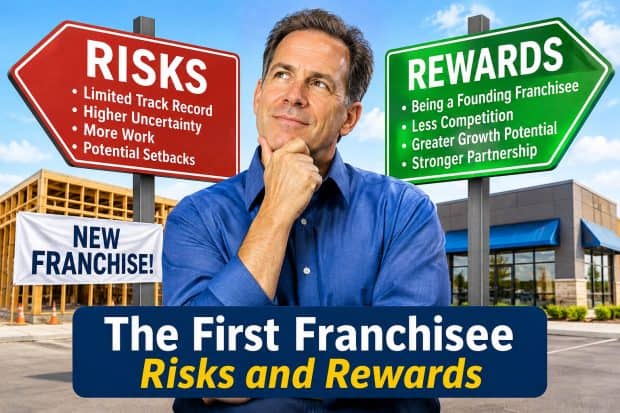
Every franchise brand you’ve ever heard of had a first franchisee.
That means someone signed before there was a playbook to fully validate.
Should that be you?
Are you looking at a brand-new franchise opportunity?
If so, have you asked yourself this question?
“Should I sign on as the first franchisee of any system?”
Keep reading to see if you should.
Key Takeaways
Being the first franchisee in a franchise system isn’t automatically reckless. It isn’t automatically smart either.
In my experience, being the first franchise owner of a franchise concept presents a different risk than buying into an established brand, and it deserves different questions.
That said, the upside can be real, especially with a concept that’s needed in your local community.
But you need to be honest about what you’re actually purchasing; a concept with promise, not a proven playbook. Anyone who can’t afford for that bet to go sideways probably shouldn’t be the one taking it.
The Appeal of Being the First Franchisee is Real
New franchise owners in a growing system often get the best territories. As in first dibs.
In addition, they get direct access to the founders, not a regional developer three layers removed.
Check Out My New Guide for Franchise Buyers!

Plus, fees are frequently lower before the brand raises prices to match demand.
And if the concept takes off, early operators can end up owning the strongest, most established locations in the system years later.
For example, Breadless, which I just wrote about, has some things going for it.
For example, it has multiple corporate locations already open.
It has stadium concession deals that build brand awareness fast.
Finally, it has a waitlist of more than 50 interested operators, which suggests real demand on the buyer side.
None of that is nothing.
The Risk of Being the First Franchisee is Also Real
Here’s what a first franchisee doesn’t get that a tenth or fiftieth franchisee does: proof.
- Proof that the unit economics work outside the founder’s home market.
- Proof that the training program actually prepares an operator who isn’t the founder.
- Proof that the supply chain holds up when it’s not one team managing everything by hand.
- Proof that the franchisor’s support team can solve problems on a Saturday night when a walk-in cooler dies.
Fact: The Item 19 in a brand-new franchisor’s FDD often has no franchisee financial performance data to show, because there isn’t any yet. You’re evaluating projections, not results. Not that having an Item 19 is everything. It’s a bunch of numbers provided by the franchisors that must be verified by you.
And know this: A concept that performs beautifully as three company-owned stores run by its founders can behave very differently once it’s handed to an independent operator paying a royalty and following an operations manual for the first time. That gap is where a lot of early-franchisee disappointment lives.
What to Actually Research in a New Franchise System
If a brand-new franchise system is genuinely on your radar, treat it differently than an established one.
Continue Learning About Franchising
Check out these important franchise trendsGet the latest franchise research tips
Learn how to choose the right franchise for you
Educate yourself about some of the franchise legal stuff
Get specific advice on owning and operating a franchise

- Ask how many corporate units exist and how long they’ve been profitable, not just open.
- Ask who is running franchise support and what their actual experience is, not just their job title.
- Ask what the franchisor’s cash position looks like, since a thin balance sheet on their end becomes your problem the moment they can’t deliver promised support.
- Ask directly what happens if the pilot franchisee locations underperform. A confident, specific answer is a good sign. A vague one is not.
Most importantly, talk to every current franchisee you can find, even if there are only a handful. With a new system, each conversation carries more weight than it would with a 300-unit chain, because your sample size is so small.
The Bottom Line
Brand-new systems aren’t good or bad by default. They’re just earlier in their story, and that story hasn’t been tested by someone other than the founders yet.
If you’re drawn to a concept because you love what it’s built so far, that’s a legitimate reason to look closer. Just make sure you’re looking closer, not just looking fast.
A waitlist of 50 hopeful operators tells you the concept is appealing.
It doesn’t tell you the concept is proven.
Those are two different things, and a buyer who treats them as the same is the buyer most likely to get burned.
About the Author
Joel Libava is The Franchise King® — an independent franchise advisor with 25+ years in the industry, two published books on franchising, and his writing has been featured in The New York Times, Forbes, CNBC, Entrepreneur® Magazine and others. In addition, he wrote exclusively for the U.S. Small Business Administration blog for eight years. He doesn't sell franchises. Instead, Joel helps you figure out if franchise ownership is actually right for you — and if it is, teaches you his powerful, proven-to-work franchise research techniques, so you can make a smart, informed decision on a franchise to own and be your own boss.
Note: When you buy through links on this website, we may earn an affiliate commission.